a selection:

Béton Brut: André Bloc and the architecture-sculpture debate

This dissertation deals with the legacy of André Bloc, who proved to be the central figure of a world-wide network of architects, artists, critics and theorists prominent within the architecture-sculpture debate. Abstract: In the 1950s, artists, sculptors and architects began to use the mass availability of concrete to create a previously impossible fusion of architecture and sculpture. This dissertation engages this understudied moment in the history of modern art, focusing on the mutual influences between sculpture and architecture as they engaged with concrete. It pays particular attention to those works that left the concrete “brut”—that is, “raw” or unfinished—and thus produced a rough aesthetic that has become an icon of post-war art. (…) Read more: Angelique Campens, Béton Brut : André Bloc and the architecture-sculpture debate(PhD diss., UGent, 2022). https://biblio.ugent.be/publication/8755696
André Bloc and the architecture sculpture debate
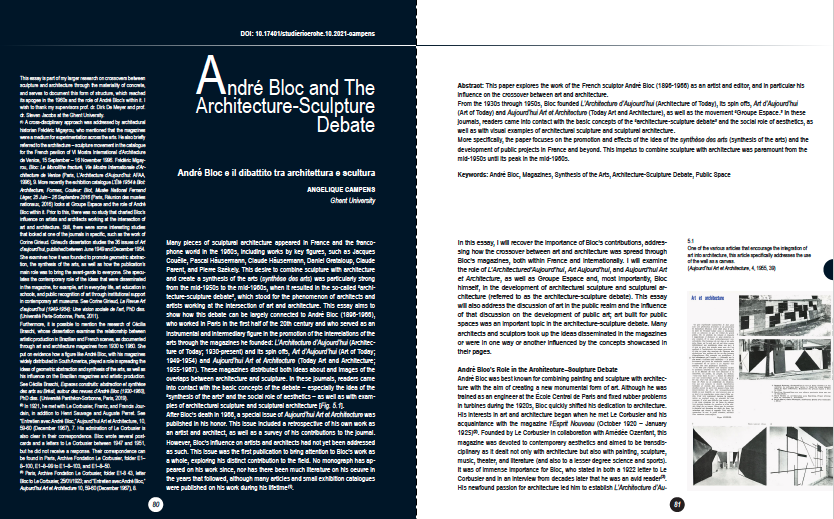
In this essay, I will recover the importance of Bloc’s contributions, addressing how the crossover between art and architecture was spread through Bloc’s magazines, both within France and internationally. I will examine the role of L’Architectured’Aujourd’hui, Art Aujourd’hui, and Aujourd’hui Art et Architecture, as well as Groupe Espace and, most importantly, Bloc himself, in the development of architectural sculpture and sculptural architecture (referred to as the architecture-sculpture debate). This essay will also address the discussion of art in the public realm and the influence of that discussion on the development of public art; art built for public spaces was an important topic in the architecture-sculpture debate. Many architects and sculptors took up the ideas disseminated in the magazines or were in one way or another influenced by the concepts showcased in their pages.
In: Studi e ricerche di storia dell’architettura, n.10 (2022):80-96 publication
Jacques Moeschal: Architecture Sculptures
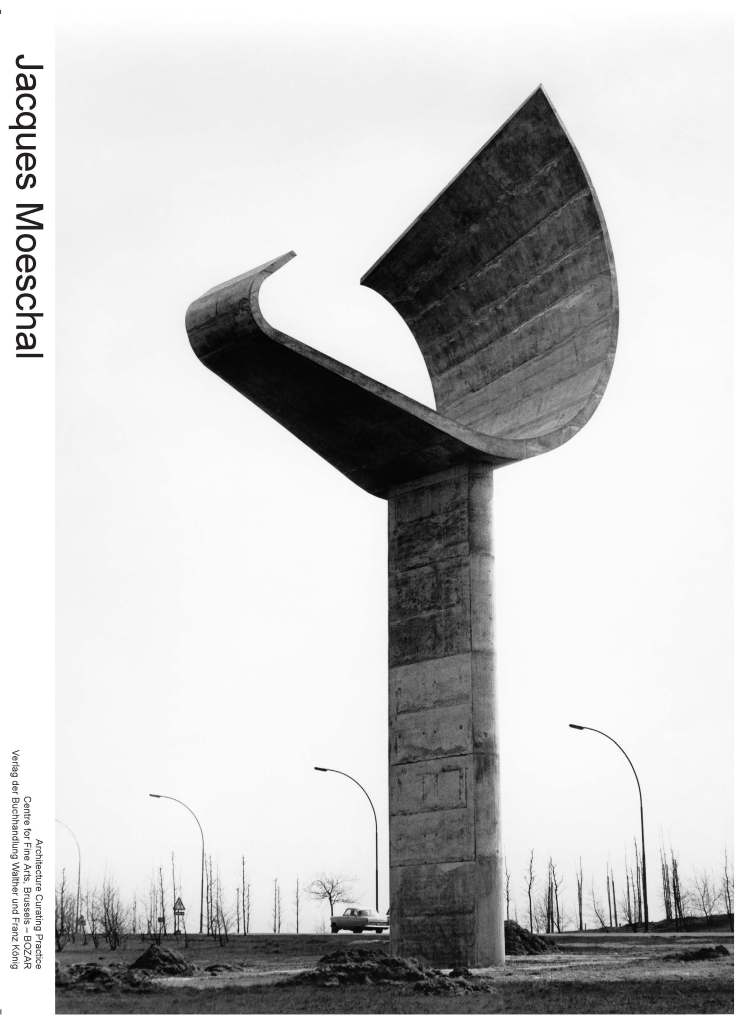
This publication delves deep into the archives of sculptor-architect Jacques Moeschal (1913-2004), known for his monumental concrete sculptures that turned Belgian car trips into art trips. His highly detailed design drawings are works of art in themselves, reproduced here on two papers alongside historic photographs. It zooms in on the relationship between art and architecture in the underexposed oeuvre of Moeschal, through rare archive materials, such as sketches, technical drawings, models, photographs, as well as contemporary images. Contemporary artists including Kasper Akhøj and Barney Kulok demonstrate how Moeschal’s work remains relevant today.
Concept by Angelique Campens and edited by Angelique Campens, Roxane Le Grelle & Iwan Strauven. Brussels 2021. 22 x 31.5 cm. 180 p. with partly col., partly full-page. ill., bibliography, paperback.
With contribution by Kasper Akhøj, Angelique Campens, Francelle Cane, Adrien de Hemptinne, Maxime Delvaux, Valéry Didelon, Ann Veronica Janssens, Barney Kulok, Sophie Lauwers, Roxane Le Grelle, Jacques Moeschal, Iwan Strauven
Designed by Justine De Spiegelaere.
ISBN: 9783753300351
https://www.buchhandlung-walther-koenig.de/
Jacques Moeschal, Signal
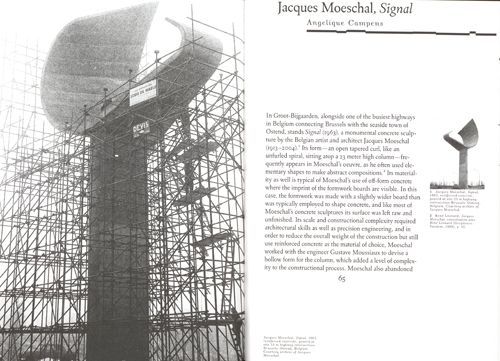
In Groot-Bijgaarden, alongside one of the busiest highways in Belgium connecting Brussels with the seaside town of Ostend, stands Signal (1963), a monumental concrete sculpture by the Belgian artist and architect Jacques Moeschal (1913–2004). Its form—an open tapered curl, like an unfurled spiral, sitting atop a 23 meter high column—frequently appears in Moeschal’s oeuvre, as he often used elementary shapes to make abstract compositions. Its materiality as well is typical of Moeschal’s use of off-form concrete where the imprint of the formwork boards are visible. In this case, the formwork was made with a slightly wider board than was typically employed to shape concrete, and like most of Moeschal’s concrete sculptures its surface was left raw and unfinished. Its scale and constructional complexity required architectural skills as well as precision engineering, and in order to reduce the overall weight of the construction but still use reinforced concrete as the material of choice, Moeschal worked with the engineer Gustave Moussiaux to devise a hollow form for the column, which added a level of complexity to the constructional process. Moeschal also abandoned (…)
In: Trading Between Architecture and Art : Strategies and Practices of Exchange, ed. Wouter Davidts, Susan Holden, and Ashley Paine (Amsterdam: Valiz, 2019): 64-73
Concrete sculptures along the road: Moeschal, Székely and Goeritz in the 1960s

This article examines a series of projects and proposals concerned with sculptures built alongside highways. It aims to illuminate an understudied history of architectural sculpture in concrete (béton), taking us beyond the traditional canon or works. These sculptures are significant within the history I trace because they are not merely influenced by architecture, but actively engage architectural forms as part of their construction of a shared private–public space along the roadside. By analysing categories such as scale, shape, mass, proportion, technological principles and the materials of the work, alongside the public context, my broader research agenda is to trace the ways in which architecture figures within and against these sculptural works. The article also traces some of the history of how art along the highway was connected through the network of the International Sculpture Symposium. The ideas that were disseminated by the different International Sculpture Symposia were important to an increasing degree and for bringing art out of museums and into public space.
In: SCULPTURE JOURNAL 27.2 (2018): 205–223.
Picasso’s Encounter with Concrete

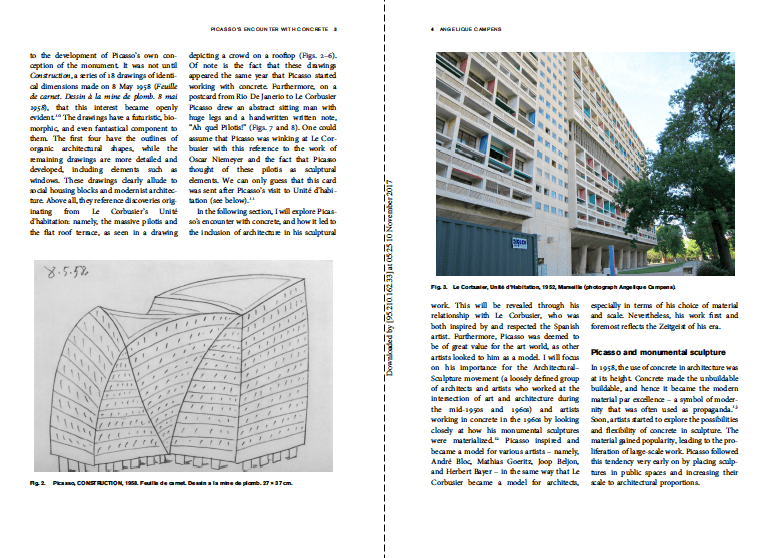
Picasso’s Encounter with Concrete reveals the links between little-known examples and canonical works of art by exploring Picasso’s somewhat understudied use of concrete in the late-1950s. It investigates how architecture as a discipline became crucial for Picasso’s artistic practice. Picasso inspired various artists in the same way Le Corbusier did architects. The material of concrete enabled artists to make larger sculptures in public spaces. As Pierre Gascar notes in Picasso et le béton, concrete has a special duality as something at once rigid and compact, but also capable of taking any form. With their roughness, Picasso’s concrete sculptures share a formal resemblance with the béton brut architecture of that time. Together with Le Corbusier, Picasso exemplifies the mutual influence and crossover between art and architecture. Picasso’s sculptures and those of various other artists working in concrete show that this material—an ultimate symbol of modernity—had implications for architecture but also for art. From the 1960s onwards, a large number of both prominent and lesser-known artists started using concrete extensively in the wake of Picasso’s experiments.
In: Konsthistorisk tidskrift/Journal of Art History Volume 87 Issue 2 (2018): 83-102.
The Sociological Dimension of Concrete Interiors During the 1960s
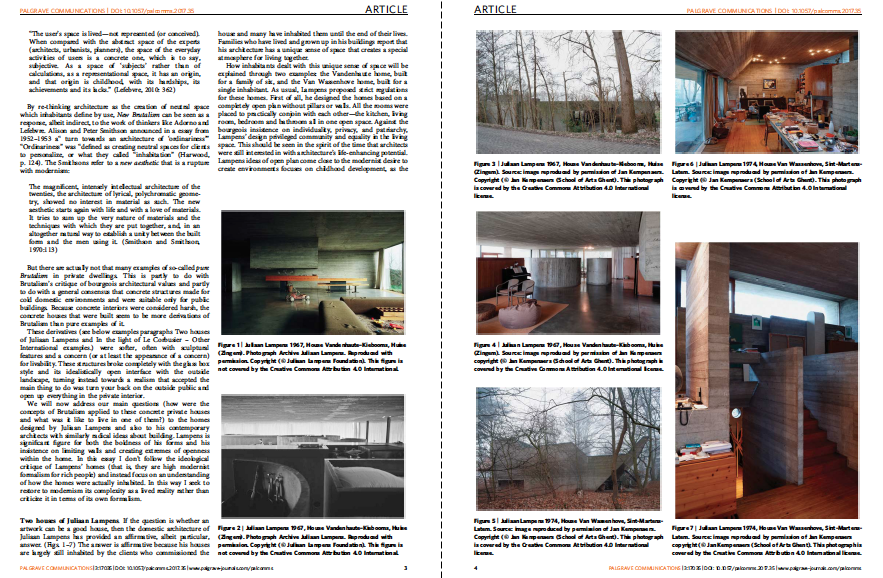
Almost all architects today have abandoned making prescriptions for how people should live. They have learned from the mistakes of Modernism, when architects sought to construct the ideal home for the family. The now nearly universal judgment is that they inhibited the very thing they promised because their ideals failed to understand that living is a continual process of growth and adaptation. Nevertheless, many modernist homes still exist, and many are strikingly beautiful, with unique aesthetic and sculptural qualities. Of particular note are homes built in the 1960s, when a series of architects used the booming trade in concrete to create buildings of the most imaginary shapes and forms. But how can the modern family make their everyday lives in a space that is itself a work of art? How are inhabitants making homes in these complex, concrete structures? How did the family unit grow and evolve in them? To answer the questions, the most proscriptive designs are the most interesting to study. They take us beyond formal analyses and into the praxis of art, where we must rely on sociology and psychology as much as aesthetics. This article will engage these broader questions through a specific focus on homes designed by Juliaan Lampens. The research draws from archival work, literature study, on-site visits and interviews. (…)This article is published as part of a collection on interiorities.
In: PALGRAVE COMMUNICATIONS 3 (2017): n. pag.
Juliaan Lampens
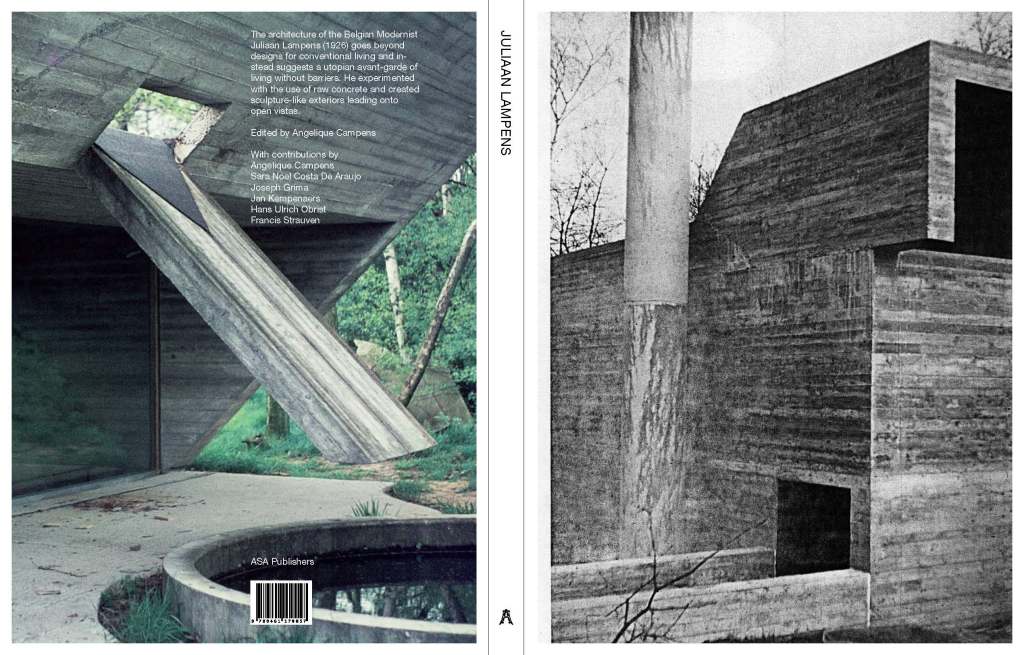
The architecture of the Belgian Modernist Juliaan Lampens (1926) goes beyond designs for conventional living and instead suggests a utopian avant-garde of living without barriers. He experimented with the use of raw concrete and created sculpture-like exteriors leading onto open vistas. Edited by Angelique Campens With contributions by Angelique Campens Sara Noel Costa De Araujo Joseph Grima Jan Kempenaers Hans Ulrich Obrist Francis Strauven
Designed by: Thomas Desmet
ISBN: 9789461178857
Campens, Angelique, ed. Juliaan Lampens. Brussels: ASA, 2011.
DOMUS
Writer and art advisor for domus (from june 2010 to june 2012
For Reasons of state
For Reasons of State examines how our ability to function as a democracy is compromised by governmental secrecy. Looking at contemporary art, the book explores notions of institutional concealment through the work of such artists as the Bureau of Inverse Technology, Jenny Holzer, Lin + Lam, Mark Lombardi, Trevor Paglen, and Susan Schluppi–all of whom provide the public with a new way of looking at information that is otherwise censored or misrepresented due to government or corporate influence.
“The Traces of Secrets” in For Reasons of State Texts by: Angelique Campens, Erica Cooke, Steve Lam 50 pages, Yale University Press, New Haven (May 2008)

Furthermore editor of catalogues: Wabi Sabi (2003), Rush (2004), Zoo Logical Garden (2005)
